





On 4 June 2026, the Minister of Health (“MoH”) issued Regulation No. 6 of 2026 on Hospitals (the “New Hospital Regulation”), which was promulgated on 12 June 2026 and became effective on that date. The New Hospital Regulation is the single, consolidated Ministerial regulation now governing the Indonesian hospital sector, and it implements Articles 823, 830, 832, 850 (5), 861 (2), 862, and 876 of Government Regulation No. 28 of 2024 (“GR 28/2024”), which in turn implements Law No. 17 of 2023 on Health (the “Health Law”).
The New Hospital Regulation is unusually broad in scope and marks a significant overhaul of Indonesia’s hospital regime. It expressly repeals and replaces 21 pre-existing regulations, consolidating and reshaping key aspects of hospital regulation in a single regulatory framework. Among the regulations that are superseded are, most notably for general healthcare business and healthcare-sector M&A as well as financing counterparties, including MoH Reg. 3/2020, MoH Regulation No. 775/MENKES/PER/IV/2011 on the Organisation of Medical Committees in Hospitals (“MoH Reg. 755/2011”), MoH Regulation No. 24 of 2014 on Class D Primary Hospitals (“MoH Reg. 24/2014”), MoH Regulation No. 10 of 2014 on Hospital Supervisory Boards, MoH Regulation No. 40 of 2022 on Technical Requirements for Hospital Buildings, Infrastructure, and Medical Equipment, and MoH Regulation No. 31 of 2022 on Teaching Hospitals.
The technical standards for risk-based business licensing in the health sub-sector under MoH Regulation No. 11 of 2025 (“MoH Reg. 11/2025”) remain in force and continue to apply in parallel to the New Hospital Regulation.
This article outlines the principal changes introduced by the New Hospital Regulation, with a particular focus on those matters most relevant to healthcare-sector M&A and financing counterparties, namely: (i) hospital classification and typology; (ii) business licensing and substantive requirements; (iii) ownership, foreign investment, and corporate form; (iv) governance, human resources, and committees; (v) assisted reproduction and specialty services; and (vi) sanctions and transitional provisions.
Overhaul of Hospital Classification and Typology
Under MoH Reg. 3/2020, hospitals were classified into General Hospitals (Rumah Sakit Umum) and Special Hospitals (Rumah Sakit Khusus). General Hospitals had four classes (A, B, C and D, with Class D further divided into Class D and Class D Primary), while Specialist Hospitals had three classes (A, B and C). The classification was largely based on minimum bed capacity, ranging from 50 to 250 beds for General Hospitals and 25 to 100 beds for Specialist Hospitals. Specialist Hospitals were also limited to 14 specified disciplines.
The New Hospital Regulation marks a fundamental shift away from the traditional A/B/C/D system. Instead, hospitals are now classified based on their actual capability to provide specific groups of services across four levels, which include: paripurna (comprehensive), utama (advanced), madya (intermediate), and dasar (basic), which are determined by reference to the actual capability of the hospital to deliver each service group, taking into account, among other things, the complexity of the diagnoses and procedures, the competencies of the medical and health workforce, and the availability of the necessary facilities and equipment. Detailed technical criteria for the classification framework are delegated to further Ministerial guidance (Article 12 of New Hospital Regulation).
In parallel, the mandatory hospital service scope has been expanded and standardised, with the New Hospital Regulation setting out twelve core service lines that every hospital must provide on an inpatient, outpatient, and emergency services basis. Pursuant to Article 13 of the New Hospital Regulation, these include:
- medical services;
- intensive care;
- surgery;
- nursing and midwifery;
- pharmacy;
- laboratory;
- radiology;
- blood services;
- nutrition;
- mortuary services;
- central sterilisation; and
- maintenance of facilities and medical equipment.
Notably, with respect to (i) blood services, (ii) nutrition, (iii) mortuary services, (iv) central sterilisation, and (v) maintenance of facilities and medical equipment, the New Hospital Regulation now expressly allows these services to be performed in cooperation with a third party. Under the previous regulatory regime, in particular Article 50 of MoH Reg. 3/2020, cooperation with a third party was permitted only for the limited purpose of managing the entire hospital, without specifying further permissible purposes.
(Articles 13 (1), 14 (1), and 15 (1) of New Hospital Regulation).
For deal parties, the practical implication is that the familiar description of a target as, for instance, a “Class B PMA general hospital” is no longer directly meaningful under the new framework. Market practice will need to migrate towards descriptions anchored in (i) the risk-based business licence and its recognised service lines, (ii) the capability tier assigned to each service group, and (iii) minimum bed and unit counts by service. During the two-year transitional period discussed below, both descriptions may need to coexist in disclosure schedules. Financiers should also anticipate a temporary loss of comparability across portfolio hospitals until the Minister publishes the promised technical guidelines.
Business Licensing and Substantive Requirements
Under the prior regime, hospital licensing was structured around two sequential permits: an establishment licence (Izin Mendirikan) and an operational licence (Izin Operasional), the latter being valid for five years and renewable subject to accreditation and self-assessment.
The New Hospital Regulation moves away from the previous permit-based structure. Pursuant to Article 6 of the New Hospital Regulation, hospitals are now required to obtain business licensing (perizinan berusaha) in accordance with the applicable laws and regulations. Under Article 7 of the New Hospital Regulation, obtaining such business licensing requires hospitals to satisfy requirements relating to their location, facilities and infrastructure, medical equipment, and healthcare human resources. With respect to location, Article 8 (1) and (2) of the New Hospital Regulation require hospitals to comply with applicable environmental health and safety and spatial planning requirements, as well as the results of a needs and feasibility assessment for the establishment of the hospital. Article 8 (3) of the New Hospital Regulation further provides that the land and buildings of a hospital must generally be located within a single integrated and interconnected area. Where the existing site has limited capacity for service expansion, Article 8 (4) of the New Hospital Regulation permits expansion to another location within the same regency or municipality, provided that accessibility to emergency and intensive care services is maintained and the Minister of Health’s approval is obtained.
For M&A and financing purposes, licensing diligence should now be conducted against the risk-based OSS record (under KBLI codes 86101 and 86103), together with the substantive hospital-condition checks under the New Hospital Regulation and the technical standards under MoH Reg. 11/2025. In this respect, particular attention should be paid to (i) whether any of the target’s operations are located on non-contiguous land and, if so, whether Ministerial consent has been obtained (and the scope of such consent); and (ii) whether the target has completed its two-year conformity work discussed below, given that the conformity status will affect both the ongoing validity of the licence and the sanctions exposure that may be inherited by an acquirer. In addition, financiers and acquirers should anticipate incremental representation-and-warranty coverage on the currency of the target’s follow-on business licences (Perizinan Berusaha untuk Menunjang Kegiatan Usaha or “PB UMKU”) for specialty services (such as radiotherapy, nuclear medicine, assisted reproduction, organ transplantation, and stem-cell services), which continue to require dedicated permits under MoH Reg. 11/2025.
Ownership, Foreign Investment, and Corporate Form
Under Article 4 of MoH Reg. 3/2020, a privately established hospital was required to be a legal entity whose business activity was solely in the hospital sector, in the form of either a not-for-profit legal entity or a for-profit limited liability company. A hospital established with foreign investment was, under the licensing standards prescribed by Article 46 (2) of MoH Reg. 3/2020, required to satisfy a bed-count floor consistent with a Class B hospital (i.e., at least 200 beds) or such other threshold as may be provided in an applicable international agreement.
The New Hospital Regulation preserves the single-purpose requirement, but the requirement is now framed more broadly. A private hospital must be a legal entity “whose business activity is only in the field of healthcare services” (with a carve-out for not-for-profit legal entities), and the New Hospital Regulation expressly confirms that a private hospital may be established with domestic or foreign investment (Article 2 (5) and (6) of New Hospital Regulation).
More significantly for deal parties, the bed-count and service thresholds have been differentiated by investment source, which according to Article 10 of New Hospital Regulation are as follows:
- A hospital with domestic investment (“PMDN Hospital”) must have at least 50 inpatient beds and provide at least two services classified at the dasar (basic) tier.
- A hospital with foreign investment (“PMA Hospital”) must have either (i) at least 50 inpatient beds and provide at least one service classified at the paripurna (comprehensive) tier, or (ii) at least 200 inpatient beds and provide at least two services classified at the paripurna (comprehensive) tier.
These thresholds are relaxed for single-specialty hospitals focused on eye, ear-nose-and-throat (“ENT”), or dental and oral services. In such cases, the bed-count minimum is reduced to 10 inpatient beds for eye or ENT hospitals and 5 inpatient beds for dental hospitals (in each case, including one intensive care bed with a ventilator). Where the specialty hospital is a PMDN Hospital, the specialty service must be provided at the madya tier, whereas where the specialty hospital is a PMA Hospital, the services must be provided at the paripurna tier. Adding any additional specialty service beyond eye, ENT, or dental services returns the hospital to the general PMDN or PMA thresholds set out above.
The single most important change for foreign investors, however, is the introduction of a group-investment carve-out. The New Hospital Regulation provides that the PMA bed-count and service thresholds do not apply to a PMA Hospital where the foreign investment takes the form of an investment in a hospital group established to support the fulfilment of healthcare needs. The carve-out is applied by reference to two criteria – (i) the cumulative investment value, and (ii) the percentage of share ownership – with the detailed criteria to be issued by the Minister. For the first time, therefore, platform-level or group-level foreign investment in the Indonesian hospital sector is expressly recognised under primary Ministerial regulation, and a route is opened for the acquisition of smaller sub-scale hospital assets that would not, on a stand-alone basis, satisfy the PMA thresholds.
Taken together, these amendments carry a number of consequences for the negotiation and drafting of transaction documentation:
- Structuring PMA acquisitions: Where the target is below the stand-alone PMA thresholds, buyers should assess whether the group-investment carve-out is or may be available, and structure the acquisition (and any related financing) around the qualifying criteria that the Minister ultimately publishes. Signing may need to be conditioned on the receipt of, or comfort on, such criteria.
- Corporate purpose: Existing PMA Hospital targets almost universally have a corporate purpose confined to hospital operations. The new definition permits activities “in the field of healthcare services” more broadly (subject to the not-for-profit carve-out), leaving open the possibility of expanded ancillary healthcare activities. Buyers considering ancillary business lines (such as diagnostics, telemedicine, or clinics) should re-examine the target’s constitutional documents accordingly.
- Financing covenants: Lenders should update the permitted-business and permitted-investment definitions in existing facility documentation to accommodate the group-investment framework and the broadened corporate-purpose scope, and consider whether any negative covenants in place may inadvertently constrain a permitted group restructuring.
Governance, Human Resources, and Committees
Under the prior regime, MoH Reg. 755/2011 required every hospital to constitute a dedicated Medical Committee (Komite Medik) as a non-structural body appointed by the hospital director, with three mandatory sub-committees responsible for credentialing, professional quality, and ethics and discipline of medical staff. A separate set of Medical Staff Bylaws (peraturan internal staf medis), drafted by the Medical Committee and endorsed by the hospital director, was required to govern the clinical governance (tata kelola klinis) of the medical staff. Parallel dedicated regulations governed the Nursing Committee (MoH Regulation No. 49 of 2013), the Ethics and Law Committee (MoH Regulation No. 42 of 2018), and the Quality Committee (MoH Regulation No. 80 of 2020). The governance framework was further supplemented by legacy guidance on Hospital By-Laws under Decree of the MoH No. 772/MENKES/SK/VI/2002.
The New Hospital Regulation repeals and consolidates all of the foregoing. In their place, it introduces two structural shifts. First, the concept of “internal hospital regulations” (peraturan internal Rumah Sakit) is reframed to comprise (i) organisational rules of the hospital (peraturan organisasi Rumah Sakit), addressing the relationship between the owner and the management of the hospital, corporate-governance principles, and the hospital’s organisational structure (Articles 61 (2) (a) and 62 (1) of New Hospital Regulation); and (ii) rules governing the medical staff and health-worker staff of the hospital (peraturan staf medis dan staf tenaga kesehatan), addressing organisation and work procedures, credentialing and clinical assignment, professional quality maintenance, professional ethics and discipline, and continuing professional development (Articles 61 (2) (b) and 64 (1) of New Hospital Regulation). Second, in place of the previously prescribed dedicated committees, the New Hospital Regulation prescribes a single, flexible “committee” concept covering, at a minimum, quality and patient safety; medical and health-worker professionalism; infection prevention, control, and antimicrobial resistance; education and training; hospital formulary and rational medicine use; ethics, research, and law; and risk management. The hospital may combine or allocate these functions across one or more committees as it sees fit.
The requirements on hospital leadership remain broadly similar in substance. Hospital leadership positions (unsur pimpinan) must be filled by medical staff, health workers, or professionals with hospital-management competence (acquired through education, training, and/or experience), and the top leader (pimpinan tertinggi) is required to have hospital operational experience (Article 39 of New Hospital Regulation). The requirement under the licensing standards (previously under MoH Regulation No. 14 of 2021, and now under MoH Reg. 11/2025) that certain key executive positions be filled by Indonesian citizens continues to apply through the licensing framework.
A further notable change relates to the Hospital Supervisory Board (dewan pengawas). Under MoH Regulation No. 10 of 2014 (“MoH Reg. 10/2014”), hospitals were required to establish a Supervisory Board, with such establishment depending on the ownership type of the hospital (Article 12 of MoH Reg. 10/2014). Under the New Hospital Regulation, however, the establishment of a Supervisory Board is discretionary, with Articles 51 and 52 providing that the hospital owner “may” establish one. Where established, the Supervisory Board comprises up to five members, may include a Ministry of Health representative at the request of the hospital owner, and is required to report to the Ministry of Health at least once a year, in addition to reporting to the owner. Where no Supervisory Board is established, oversight functions are performed by the hospital owner or an equivalent organ within the hospital’s existing structure.
In light of these changes, an acquirer’s legal due diligence on a target hospital should include a review of existing committee and internal-governance documentation against the consolidated framework introduced by the New Hospital Regulation, with particular attention to targets that have not yet rationalised their governance instruments during the two-year transitional period. Financing documentation containing information rights, board-composition covenants, or reporting requirements that reference the mandatory Supervisory Board (or the specific committees previously required under the repealed regulations) will also need to be updated. In this respect, lenders may wish to build in explicit rights of access to the new internal hospital regulations, credentialing decisions, and audited financial statements, noting that the New Hospital Regulation now requires audited annual financial statements to be filed with the Ministry of Health.
Specialty Services
Under MoH Reg. 3/2020, hospitals wishing to provide certain specialty services – radiotherapy, nuclear medicine, assisted reproduction (kehamilan dengan bantuan atau kehamilan di luar cara alamiah), organ transplantation, and stem-cell therapy for research-based services – were required to obtain a discrete permit from the MoH in addition to their general operational licence (Perizinan Berusaha Untuk Menunjang Kegiatan Usaha or “PB UMKU”). The technical standards for these specialty services were subsequently incorporated into the risk-based business licensing framework under MoH Reg. 11/2025, with the relevant appendices setting out service-specific requirements covering facilities, medical equipment, and qualified healthcare personnel. The applicable PB UMKUs remain subject to the issuance and renewal requirements under MoH Reg. 11/2025.
The New Hospital Regulation does not itself replicate Article 28 of MoH Reg. 3/2020. However, because the operative licensing regime for such services is MoH Reg. 11/2025, which remains in force, the requirement for hospitals to obtain the relevant PB UMKU for applicable specialty services continues to apply. The New Hospital Regulation instead places these requirements within the broader hospital licensing framework, while Article 13 of the New Hospital Regulation sets out the core services that hospitals are required to provide and does not remove the separate licensing requirements applicable to specialty services.
In practical terms, hospitals providing specialty services must continue to comply with the applicable PB UMKU requirements under MoH Reg. 11/2025, while also satisfying the new hospital licensing and service-capability requirements under the New Hospital Regulation. This is particularly relevant for M&A and financing counterparties, which should assess both the hospital’s general licensing position and any additional PB UMKUs required for its specialty services, including their validity and compliance with the applicable technical standards.
Sanctions and Transitional Provisions
Article 79 of the New Hospital Regulation introduces a full administrative-sanctions framework applicable to breaches of a hospital’s core obligations (Article 36 paragraph (1)), its quality-improvement obligation, both internal and external (Article 67 paragraph (1)), its audited financial reporting obligation (Article 73 paragraph (1)), and its recording and reporting obligation through the National Health Information System (Article 74 paragraph (1)). The sanctions escalate on a tiered basis, as summarised below:
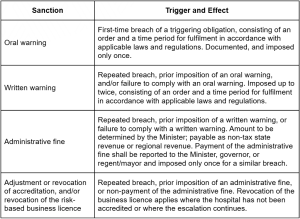
A separate sanctions mechanism also applies to breaches of teaching-hospital obligations (which may lead to the revocation of the teaching-hospital designation) and to research-related breaches under Article 34 (limited to oral and written warnings).
More significantly, Article 80 of the New Hospital Regulation provides for non-tiered sanctions where a breach results in (i) patient death; (ii) permanent disability or organ damage; (iii) wide-scale harm to healthcare provision; (iv) financial mismanagement or loss to the hospital; (v) failure of managerial function causing revocation of the business licence or a direct impact on patient safety; or (vi) conviction of the hospital’s leadership for a criminal offence by a final court decision. In such cases, sanctions may be imposed directly, without following the tiered escalation described above.
Article 71 of the New Hospital Regulation also introduces a National Tariff Pattern (pola tarif nasional) to be set by the Minister and a Maximum Tariff Ceiling (pagu tarif maksimal) to be set by each Governor at the provincial level. Pending the publication of the Governor’s ceiling, hospitals are required to apply the National Tariff Pattern. This new price-cap architecture may in turn affect the revenue models supporting healthcare-sector financing packages, and deal parties should reflect the position accordingly in their base cases and downside scenarios.
As to the transitional arrangements, Article 83 provides that all existing hospitals must conform their operations to the New Hospital Regulation within two years of promulgation, i.e., by 12 June 2028. Class D Primary hospitals with existing business licences (and any Class D Primary hospital that intends to operate as a hospital) have four years, i.e., until 12 June 2030. Given that MoH Reg. 24/2014 has been repealed but the category has been preserved for transitional purposes, Class D Pratama operators and their investors should expect further Ministerial guidance on how existing licences will map to the new capability-tier classification framework.
Concluding Remarks
Taken together, the amendments introduced by the New Hospital Regulation represent one of the most significant single-instrument reforms of the Indonesian hospital sector in recent memory. By consolidating twenty-one prior regulations into a single instrument, moving from bed-count-driven classification to a capability-tier framework, differentiating bed-count and service floors by investment source, expressly recognising group-level foreign investment through a purpose-built carve-out, and introducing a tiered sanctions ladder (together with non-tiered sanctions in the more serious cases), the New Hospital Regulation reshapes both the operational and the transactional landscape for hospital operators, foreign investors, and financing counterparties alike. While a number of the operational parameters remain to be filled in through further Ministerial guidance – notably the detailed classification criteria and the group-investment carve-out criteria – the direction of travel is now clear, and market participants would be well advised to begin updating their transactional templates, diligence scopes, and portfolio conformity roadmaps in anticipation of the June 2028 transitional deadline.
Disclaimer: The information herein is of general nature and should not be treated as legal advice, nor shall it be relied upon by any party for any circumstance. Specific legal advice should be sought by interested parties to address their circumstances.