








In the beginning of this year on 2 January 2026, the Government of Indonesia has officially enacted Law No. 1 of 2026 on Criminal Adjustment (“Law 1/2026”). Law 1/2026 introduces several amendments to Law No. 1 of 2023 on the Indonesian Criminal Code (the “New Criminal Code”), effective since its date of enactment. Among the changes to the previous criminal code stipulated in this New Criminal Code is specific stipulation on the applicable criminal penalties for corporations.
This article outlines the principal changes introduced by Law 1/2026, particularly those affecting the criminal liability and sanctions applicable to corporations and their management.
Corporate Criminal Liability
Under Article 49 of the New Criminal Code, the liability for offences committed by a corporation may be imposed on the corporation, its functional management, the person giving orders, and/or the beneficial owners of the corporation.
Law 1/2026 further amends Article 49 to clarify that criminal liability is imposed on the corporation first. Liability may, thereafter, be imposed on the corporation’s management, the person giving orders, and/or the corporation’s beneficial owners, subject to the applicable legal requirements. In this respect, the amendment is intended to reaffirm that the corporation and the individuals behind its management or control remain distinct legal actors. Therefore, maintaining the legal basis for extending criminal liability to such individuals should be justified under the law.
Further Enforced Sanctions on Corporations
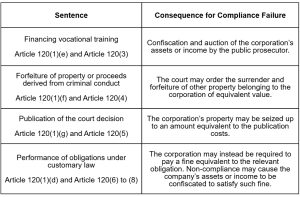
Under Article 118 of the New Criminal Code, a corporation is subject to two types of penalties, namely principal and additional penalties. In relation to the additional penalties, Law 1/2026 further amends Article 120 to clarify the consequences that may follow when a corporation fails to comply with the additional penalty imposed by the court.
The table below summarises the consequences for non-compliance with each form of additional penalty:
Furthermore, the New Criminal Code, introduces a new Article 121(3), whereas, if a corporation is sentenced to a category VIII fine and the judge considers that such fine is insufficient to achieve the objective of sentencing, the judge may impose a further fine of up to 10% of the corporation’s annual profit for the financial year preceding the judgment.
Taken together, these amendments suggest a more structured approach to the enforcement of penalties against corporations, particularly by clarifying the consequences of non-compliance with additional penalties and by allowing, in certain circumstances, a fine to take into account the corporation’s financial position.
Removal of the Limitation Period for the Prosecution of Corporations
Article 132 paragraph 2 of the New Criminal Code is amended to provide that the authority to prosecute a corporation does not lapse in the event of bankruptcy, change of name, merger, consolidation, acquisition, demerger, or dissolution.
Read together with the adjustments to corporate criminal liability, this amendment indicates that certain corporate actions or restructuring measures do not, in themselves, necessarily eliminate the corporation’s criminal exposure. In that regard, parties involved in the restructuring, acquisition, or takeover of a corporation may wish to pay closer attention to the corporation’s historical conduct and potential criminal liabilities, particularly as such liabilities may remain relevant notwithstanding subsequent changes to the corporation’s structure or status.
Concluding Remarks
Taken together, the relevant amendments under Law 1/2026 appear to mark a meaningful development in the treatment of corporations under Indonesian criminal law, by clarifying that criminal liability is to be anchored in the corporation before it may extend further to those who manage or control it, by reinforcing the enforceability and potential economic weight of sanctions imposed on corporate offenders, and by limiting the extent to which changes in corporate form or status may interrupt prosecutorial exposure. Read in this light, these adjustments are not merely technical in character, but reflect a broader legislative inclination to preserve the integrity of corporate criminal accountability beyond formal restructurings or internal changes, while at the same time underscoring the growing importance of robust compliance systems, careful governance oversight, and disciplined legal due diligence in matters involving corporate transition.
Disclaimer: The information herein is of general nature and should not be treated as legal advice, nor shall it be relied upon by any party for any circumstance. Specific legal advice should be sought by interested parties to address their circumstances.