




Indonesia’s halal product assurance initiatives have undergone a significant development following the enactment of Government Regulation No. 42 of 2024 on Implementation of the Halal Product Assurance (“GR 42/2024”). As of 17 October 2024, Government Regulation No. 39 of 2021 on the Implementation of Halal Product Assurance (“GR 39/2021”) has been officially revoked and replaced by GR 42/2024.
The issuance of GR 42/2024 reflects the Government’s commitment to strengthening the legal certainty and ensuring that the products circulating in Indonesia comply with the halal requirements. This initiative is particularly important given Indonesia’s large Muslim population, for whom halal compliance is a key consideration in accordance with Islamic principles and values.
Accordingly, this article highlights the key regulatory updates introduced by GR 42/2024 and examines their implications for businesses manufacturing, importing, distributing, or marketing products in Indonesia. It also provides an overview of the updated halal certification framework for business actors seeking to obtain halal certification and ensure compliance with the prevailing laws and regulations.
Scope of Products Subject to Halal Certification
The scope of products subject to halal certification under GR 42/2024 remains substantially unchanged compared to such scope under the previous regulatory regime. Pursuant to Article 2 of GR 42/2024, every product that enters, circulates, and is traded within the territory of Indonesia must be halal-certified, except for products derived from materials that are classified as haram under Islamic law. Such products are exempted from the halal certification requirement, but clear non-halal information must be available on the products in accordance with the applicable laws and regulations.
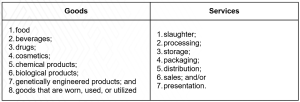
For implementation purposes, GR 42/2024 adopts a broad definition of “Product”. Pursuant to Article 1(2) of GR 42/2024, Products can be goods or services related to food, beverages, drugs, cosmetics, chemical products, biological products, genetically engineered products, or goods that are worn, used, or utilized by the public. Article 155 of GR 42/2024 further sets out the following categories of goods and services subject to the mandatory halal certification obligation:
Notwithstanding the largely unchanged scope of products under halal certification, GR 42/2024 introduces updates on the implementation of the mandatory halal certification regime. In particular, the regulation reaffirms that the halal certification obligation should be carried out in phases based on the category of products and scale of the business actors.
Pursuant to Article 159 of GR 42/2024, the mandatory halal certification requirement is implemented gradually. Article 160 of GR 42/2024 further prescribes the applicable implementation period for food products, beverages, slaughtered products, and slaughtering services.
For medium-sized to large business actors, the implementation period started on 17 October 2019 and ended on 17 October 2024. Accordingly, the products must have obtained the halal certification by 17 October 2024.
For micro and small enterprises (Usaha Mikro dan Kecil or UMK), the implementation period started on 17 October 2019. It would end on 17 October 2026, thereby providing an additional two-year transition period for compliance.
With respect to imported food products, beverages, slaughter products, and slaughtering services originating from outside Indonesia, Article 160 (3) of GR 42/2024 provides that the obligation to obtain halal certification will be determined by the Minister no later than 17 October 2026, taking into account the completion of mutual recognition arrangements for foreign halal certificates and coordination with the relevant governmental authorities.
In light of the above, the Government expects that all products already entering, circulating, and being traded within the Indonesian market have obtained the mandatory halal certification.
Halal Certification Procedure
The procedure for obtaining halal certification under GR 42/2024 is generally consistent with the one under the previous regulatory framework. Pursuant to Article 67 (1) and (2) of GR 42/2024, an application for a halal certificate must be submitted electronically to the Halal Product Assurance Organizing Agency (Badan Penyelenggara Jaminan Produk Halal or “BPJPH”) in the Indonesian language.
The application must be accompanied by the following information and supporting documents:
- the business actor’s information;
- name and type of product;
- list of products and the materials used in the relevant products; and
- the product processing method and procedures.
Once the application has been verified as complete, BPJPH will appoint a Halal Inspection Institution (Lembaga Pemeriksa Halal or “LPH”) to conduct a document review and an inspection and/or testing of the product’s halal compliance. Such inspection and/or testing is carried out by halal auditors through an on-site assessment of the relevant product and production process.
Notably, GR 42/2024 introduces greater legal certainty with respect to the timeline for the halal certification process. Pursuant to Article 86 of GR 42/2024, the result of a halal certification hearing must be submitted within 3 days following the completion of the inspection and/or testing of the product.
This represents a departure from the previous GR 39/2021, under which the timeline for the submission of the result was calculated from the completion of the required documentation, not the inspection and/or testing process. Accordingly, GR 42/2024 provides a clearer and more measurable timeline for business actors by linking the relevant deadline directly to the inspection and/or testing stage of the halal certification process.
Self-Declaration of Halal Certification
The self-declaration mechanism of halal certification for eligible micro and small enterprises (“MSEs”) is available under GR 42/2024. Similar to the previous framework under GR 39/2021, the mechanism applies to MSEs whose products are considered low-risk or use materials with confirmed halal status, and the ones whose production processes are simple and in compliance with the halal requirements (Article 98 (2) of GR 42/2024).
While the underlying concept remains unchanged, GR 42/2024 introduces several notable refinements to provide greater legal certainty and improve the efficiency of the certification process.
One notable amendment concerns the authority responsible for confirming the halal status. Under Article 79 (6) of GR 39/2021, BPJPH was required to forward the business actor’s declaration to the Indonesian Ulema Council (Majelis Ulama Indonesia or “MUI”), which would subsequently conduct a halal fatwa session before BPJPH could issue the halal certificate. Under Article 98 (5), (8), and (9) of GR 42/2024, this role has been transferred to the Halal Product Fatwa Committee (Komite Fatwa Produk Halal), which is now responsible for confirming the halal status before BPJPH issues the halal certificate.
GR 42/2024 also introduces the statutory timelines not expressly provided under the previous regulation. Pursuant to Article 98 (8) and (9) of GR 42/2024, the Halal Product Fatwa Committee must determine the halal status of the product within one day after receiving the complete documents. BPJPH must issue the halal certificate within one day after receiving the halal determination from the Committee.
Halal Mark and Non-Halal Declaration
Once a product has been successfully registered and a halal certificate has been issued, GR 42/2024 continues to require the business actor to affix the halal label on the relevant product. Pursuant to Article 109 of GR 42/2024, the halal label must be displayed on (i) the product packaging, (ii) a specific part of the product, and/or (iii) a specific location on the product. In addition, the halal label must be affixed in a manner that is clearly visible, easily readable, and is not easily removable or detachable.
While the general requirement to affix a halal label remains substantially unchanged, GR 42/2024 introduces an additional exemption to this obligation. Under GR 39/2021, the requirement to affix a halal label did not apply to products with very small packaging, products that are sold and packaged directly in the presence of the purchaser in small quantities, or products sold in bulk.
GR 42/2024 expands these exemptions. Pursuant to Article 109 (3) of GR 42/2024, the obligation to affix a halal label does not apply to products that are sold on a limited basis. The elucidation of Article 109 (3) of GR 42/2024 provides examples of “products sold on a limited basis,” such as products intended for specific purposes, such as food products formulated for the dietary management of certain medical conditions and the ones sold pursuant to a doctor’s prescription.
GR 42/2024 also retains the obligation for business actors of products derived from materials classified as haram under Islamic law to provide a non-halal declaration. While this obligation remains substantially unchanged compared to that under the previous regulatory framework, Article 110 of GR 42/2024 no longer prescribes the specific form and placement of the non-halal declaration. Instead, the regulation delegates the authority to determine the form and procedure for affixing the non-halal declaration to BPJPH, following coordination with the relevant ministries and government agencies, thereby providing greater flexibility in the implementation of the labelling requirement.
Registration on Foreign Halal Certificate
GR 42/2024 also refines the regulatory framework governing the registration of foreign halal certificates. While the overall mechanism remains substantially similar to that under Articles 125 to 134 of GR 39/2021, the new regulation introduces several amendments aimed at providing greater legal certainty, streamlining the registration process, and clarifying the circumstances in which foreign products may rely on foreign halal certificates or are, instead, required to obtain halal certification in Indonesia.
One notable clarification is introduced under Article 146 of GR 42/2024, which expressly sets out the circumstances in which foreign products must obtain the halal certification in Indonesia.
Unlike the previous regulation, which generally required foreign products to be certified in Indonesia where the relevant foreign halal institution was not recognised, Article 146 of GR 42/2024 provides that foreign products must obtain halal certification in Indonesia, when:
- there is no halal institution in the country of origin;
- the recognised foreign halal institution does not have the relevant certification competency;
- no mutual recognition arrangement has been established between the foreign halal institution and BPJPH; or
- the business actor voluntarily elects to obtain halal certification in Indonesia.
Where a halal certificate has been issued by a foreign halal institution that has entered into a mutual recognition arrangement with BPJPH, Article 147 of GR 42/2024 continues to recognise such certificate without requiring the business actor to obtain a new halal certificate in Indonesia. Nevertheless, the foreign halal certificate must first be registered with BPJPH before the relevant products may be circulated in the Indonesian market.
GR 42/2024 modernises the registration procedure. Under Article 148 of GR 42/2024, applications for the registration of foreign halal certificates must be submitted electronically through an integrated system to BPJPH. While GR 39/2021 already required BPJPH to review the completeness and authenticity of the submitted documents, Articles 149 and 150 of GR 42/2024 expressly prescribes the timeframe for carrying out such reviews. In particular, BPJPH must finalize the document’s completeness review within 5 days after receiving the application, and its authenticity review within a further 5 days after the application has been declared complete.
GR 42/2024 also provides greater clarity regarding the party responsible for submitting an application for halal certification. Under Article 146, the application must be submitted by the business actor through its importer or official representative established in Indonesia, replacing the previous framework under Article 126 of GR 39/2021, which required the application to be submitted by the importer or its official representative.
Closing Remarks
Although GR 42/2024 does not fundamentally alter Indonesia’s halal product assurance framework, it introduces a number of important refinements that enhance the legal certainty, improve the procedural efficiency, and provide greater clarity for business actors seeking to comply with the halal certification requirements. These include clearer implementation timelines, more detailed procedures for self-declaration certification and the registration of foreign halal certificates, as well as refinements to the rules governing halal labelling and non-halal declarations.
Notably, GR 42/2024 does not prescribe substantive criteria governing the Minister’s stipulation on the implementation of halal requirements for imported products, beyond requiring the completion of mutual recognition arrangements for foreign halal certificates and coordination with the relevant ministries and agencies. As a result, the timing and scope of the mandatory halal certification obligation for imported products will depend on the future implementing regulations under a ministerial-level regulation.
As the implementation of mandatory halal certification continues to be phased across different product categories, business actors should ensure that their products and internal compliance processes are aligned with the updated regulatory framework. This is particularly relevant to both domestic and foreign businesses intending to manufacture, import, distribute, or market their products in Indonesia, as failure to comply with the applicable requirements may result in administrative sanctions under GR 42/2024.
Disclaimer: The information herein is of general nature and should not be treated as legal advice, nor shall it be relied upon by any party for any circumstance. Specific legal advice should be sought by interested parties to address their circumstances.