




The Ministry of Forestry (“MoF”) has recently promulgated MoF Regulation No. 6 of 2026 on Procedures for Carbon Trading Through Forestry Sector Greenhouse Gas Emission Offsets (“MoF Reg. 6/2026”) on 13 April 2026, which substantiates the government’s commitment to establishing a firmer framework for controlling and trading greenhouse gas emissions (Gas Rumah Kaca or “GRK”), as governed by President Regulation No. 110 of 2025 on Implementation of the Carbon Economic Value Instrument and National Greenhouse Gas Emission Control.
This new MoF Reg.6/2026 replaces the Ministry of Environment and Forestry (currently MoF) Regulation No. 7 of 2023 on Procedures for Carbon Trading in the Forestry Sector (“MoEF Reg. 7/2023”), MoF Reg. 6/2026 further establishes the operational procedures for carbon trading activities in the forestry sector through new obligations and standards relating to carbon credits. We have set out below the key changes introduced under MoF Reg. 6/2026 that business actors should be aware of.
Eligible Trading Actors
MoF Reg. 6/2026 emphasizes the obligation to undertake climate change mitigation actions to reduce GRK emissions, primarily by governors, the MoF, and business actors. One of the prescribed mitigation measures is increasing carbon sequestration and/or enhancing carbon stock storage. To support these efforts, the regulation identifies the business actors eligible to develop and trade forestry-based carbon credits, namely:
- holder of forestry utilization business license (Perizinan Berusaha Pengelolaan Hutan or “PBPH”) or other forest management rights;
- holder of social forestry management approval;
- customary law communities with legally recognized forest status;
- holder of private forest rights; and
- holder of carbon environmental services utilization business license (Perizinan Berusaha Pemanfaatan Jasa Lingkungan Karbon or “PB-PJL”).
(Article 6 (1) of MoF Reg. 6/2026)
The regulation also distinguishes the manner in which these entities may participate in carbon trading. Social forestry approval holders, customary law communities, and private forest rights holders must engage a registered partner to undertake GRK emissions trading (Article 6 (2) of MoF Reg. 6/2026). Meanwhile, PBPH holders and PB-PJL holders may collaborate with third parties in implementing mitigation activities and carbon trading, but remain responsible and accountable for such activities (Article 8 of MoF Reg. 6/2026).
The distinction reflects the MoF’s different regulatory approach to project implementation. While certain project proponents must participate through registered partners, PBPH and PB-PJL holders remain the primary regulated entities even where project implementation is outsourced, meaning contractual delegation does not reduce their regulatory accountability.
Carbon Unit Classification
MoF Reg. 6/2026 introduces a dual classification system for forestry-based carbon unit trading, namely (i) the GRK Emission Reduction Certificate (Sertifikat Pengurangan Emisi GRK or “SPE GRK”) and (ii) non-SPE GRK (i.e., internationally certified carbon units). Please see the table below for ease of reference on the difference between the two:
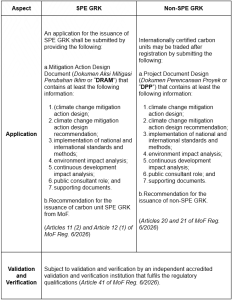
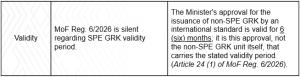
The dual classification primarily differentiates the administrative pathway through which forestry-sector carbon units are recognised and traded. By expressly accommodating both nationally registered and internationally certified carbon units within a single regulatory framework, MoF Reg. 6/2026 provides greater procedural certainty for projects pursuing different certification and commercialization strategies while maintaining a consistent regulatory baseline for project assessment.
At the time MoF Reg. 6/2026 was promulgated, the Ministry of Environment’s Carbon Unit Registration System (Sistem Registrasi Unit Karbon or “SRUK“) had not yet been implemented, and DRAM and DPP submissions continued to be processed through the MoF’s online system. Once implemented, submissions are intended to be made through the SRUK. As implementation progresses, businesses should monitor the applicable registration mechanism, together with any further implementing regulations or technical guidelines governing the submission process.
Designated Project Areas
MoF Reg. 6/2026 simplifies the categories of forest areas eligible for the generation of forestry-based carbon units compared with MoEF Reg. 7/2023. Notably, under Article 9 (1) of MoF Reg. 6/2026, forestry-based carbon units may only be generated from the following areas:
- permanent production forest, convertible production forest, and/or utilization block of protected forest that has been granted with business license, utilization approval, or rights;
- utilization zones or block of nature conservation areas and hunting parks that has not yet been granted with utilization rights, business license, or cooperation arrangement;
- customary forest;
- forest rights area (hutan hak); and
- state land outside designated forest areas.
These eligibility criteria elevate project location from a technical project consideration to a threshold regulatory requirement. Unlike the previous framework, which recognised a broader range of project areas, MoF Reg. 6/2026 adopts a more defined list of eligible locations. Consequently, the legal status of the proposed project area will become an increasingly important consideration during project development and due diligence, particularly for new projects seeking to generate forestry-sector carbon units.
Post-Issuance Safeguards
Beyond regulating the issuance and trading of forestry-sector carbon units, MoF Reg. 6/2026 introduces continuing obligations aimed at ensuring that carbon projects are implemented in accordance with prescribed social and environmental safeguard principles. Following the trading of forestry-sector carbon units, project proponents are required to implement safeguards covering, among others:
- compliance with the laws and consistency with national forestry programmes;
- transparency and effectiveness in forest governance;
- protection of the rights of indigenous peoples and local communities;
- effective stakeholder participation;
- consistency with natural forest and biodiversity conservation;
- measures to address the risk of reversals; and
- measures to reduce emission leakage (pengalihan emisi).
(Article 28 (2) of MoF Reg. 6/2026)
Complementing these obligations, Article 29 of MoF Reg. 6/2026 requires project proponents to implement a risk management system to address risks arising from climate change mitigation activities and carbon trading.
The introduction of safeguard and risk management obligations reflects an expectation that project proponents maintain appropriate governance throughout the project lifecycle, rather than treating carbon unit issuance as the completion of their regulatory obligations. Consequently, operational aspects such as stakeholder engagement, environmental safeguards, and risk management are likely to assume greater significance alongside the technical delivery of emission reductions.
Compliance
To facilitate regulatory oversight of climate change mitigation activities and carbon trading, MoF Reg. 6/2026 requires project proponents to submit reports to the MoF through the designated electronic system. According to Article 54 of MoF Reg. 6/2026, the reports must include, at a minimum:
- the implementation of carbon trading through GRK emission offsets;
- community participation in the implementation of climate change mitigation activities;
- the implementation of benefit-sharing arrangements; and
- follow-up measures taken in response to public complaints relating to carbon trading.
Separately, project proponents are also required to report on the implementation of the safeguard principles as described in Section 4 (Article 28 (3) of MoF Reg. 6/2026).
Although MoF Reg. 6/2026 does not prescribe a reporting frequency, the scope of the required reports extends beyond technical aspects of carbon trading to include broader governance and stakeholder-related matters. This suggests that the MoF’s supervisory function is intended to cover not only the generation and trading of carbon units, but also the ongoing implementation of forestry-sector carbon projects. From a compliance perspective, project proponents may therefore need to maintain more comprehensive project documentation to support future reporting and regulatory oversight once implementing guidance is issued.
Transitional Provision
Article 61 of MoF Reg. 6/2026 does not create a general transitional period for the regulation as a whole. Instead, it requires holders of (i) validated DRAM and DPP, implemented, or verified climate change mitigation actions (including where reporting on such actions is outstanding), and (ii) carbon units that have not yet been traded, to report such activities to the MoF no later than 6 (six) months from the regulation’s enactment on 13 April 2026.
Project proponents with activities initiated under the previous regime should therefore ensure that any applicable reporting requirements have been fulfilled and continue to monitor subsequent guidance governing the administration of existing projects, particularly through the SRUK.
Disclaimer: The information herein is of general nature and should not be treated as legal advice, nor shall it be relied upon by any party for any circumstance. Specific legal advice should be sought by interested parties to address their circumstances.