






On 5 January 2026, the Minister of Energy and Mineral Resources (“MoEMR”) issued MoEMR Regulation No. 1 of 2026 on Energy Conservation Service Business (“MoEMR Reg. 1/2026”). This regulation strengthens the regulatory framework for energy conservation established under Government Regulation No. 33 of 2023 on Energy Conservation (“GR 33/2023”), by providing further technical details, including the types of business activities in the energy conservation sector.
In this article, we highlight the key points in MoEMR Reg. 1/2026, particularly the: (i) eligible entities; (ii) scope of business; (iii) business models; and (iv) reporting obligations and associated sanctions.
Eligible Entities
Article 3 of MoEMR Reg. 1/2026 identifies the three categories of entities that are eligible to act as service providers in the energy conservation sector, namely:
- incorporated business entities (i.e., a limited liability company);
- public service agencies; and
- the Technical Implementing Unit (Unit Pelaksana Teknis), namely an independent work unit that carries out certain technical operational duties and/or specific technical supporting duties of an organizational unit within a ministry or government agency.
(collectively, “Energy Conservation Service Provider(s)” or “ECSP”)
Pursuant to Article 5 of MoEMR Reg. 1/2026, an ECSP may work with other parties, as the energy utilizers, through an Energy Efficiency Project (“EEP”) to manage the conserved energy. These parties include: (i) energy providers; (ii) energy users; and/or (iii) energy source users (collectively, the “User(s)”)
Scope of Business
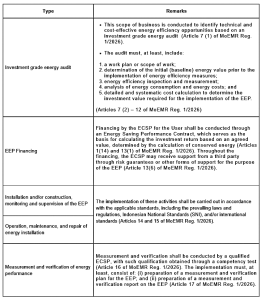
Article 6 of MoEMR Reg. 1/2026 sets out the scope of services provided by ECSP. In particular, it elaborates on five types of energy conservation business activities and their implementation, as summarized below:
Business Model
The business arrangement between an ECSP and a User shall be set out in an agreement. The agreement must state the business model for the EEP as a basis of the service provisions for the User. Article 18 of MoEMR Reg. 1/2026 recognizes the following business models:
- Energy-Guaranteed Saving: the ECSP guarantees achievement of the agreed energy savings within a specified period, to support the return of the User’s investment.
- Energy-Shared Saving: the ECSP and the User share savings in energy consumption in accordance with the specific portion within an agreed period to return the investment of the ECSP.
- Build, Operate, and Transfer: the User pays the ECSP for the construction and operation of EEP assets, and the ownership is transferred to the User at the end of the payment period.
- Build, Operate, and Own: the User pays the ECSP for the construction and operation of EEP assets by the ECSP, without any transfer of the assets.
- Energy as a Service: the User pays the ECSP for energy saving services measured against parameters applicable to each energy type. The services may include cooling, heating, lighting, and steaming the energy, and other services.
Reporting Obligations and Associated Sanctions
MoEMR Reg. 1/2026 (Articles 21 – 23) establishes reporting obligations for ECSPs as part of MoEMR’s supervisory oversight of EEP implementation:
- Initial Report: an ECSP must submit an initial report to MoEMR once within 14 working days after the issuance of its energy conservation business license.
- Business Expansion Report: Any ECSP that expands its energy conservation business must report to MoEMR within 14 working days after the expansion is approved.
- Annual Mandatory Report: As a recurring supervisory measure, an ECSP must submit an annual report to MoEMR no later than 31 December of each corresponding year, or at any time as required by MoEMR.
Failure to comply with these reporting obligations may result the ECSP subject to administrative sanctions in the form of a written warning.
Concluding Remarks
MoEMR Reg. 1/2026 marks an important step in strengthening Indonesia’s regulatory framework for energy conservation services by providing clearer technical parameters on the eligible entities, scope of services, recognized business models, and reporting obligations, which in turn, supports greater certainty for market participants in structuring and implementing EEP.
Business actors that have entered or intend to enter the Indonesian market as ECSPs should ensure ongoing compliance with the applicable licensing and reporting requirements, and carefully structure their contractual and business arrangements, by selecting the most appropriate business model. Proper alignment with this regulation will enable businesses to operate compliantly, while capturing opportunities in Indonesia’s growing energy efficiency sector.
Disclaimer: The information herein is of general nature and should not be treated as legal advice, nor shall it be relied upon by any party for any circumstance. Specific legal advice should be sought by interested parties to address their circumstances.